30 Year Recertification: The #1 Ultimate Florida Guide
For decades, Florida condo boards and property managers operated under a simple rule: the “40-Year Recertification.” It was a standard milestone that everyone understood. However, recent legislative changes have fundamentally shifted the timeline, creating confusion across the state. The new standard is the 30 year recertification, and for many buildings, the deadline is even sooner.
If you are asking, “When is my building actually due?” you are not alone. This comprehensive guide will decode the new timeline, explain the “Coastal Rule,” and help you prepare for your mandatory milestone inspections.
Table of Contents
The Shift from 40 to 30 Years: What Changed?
Following the Surfside tragedy, the Florida Legislature passed Senate Bill 4-D (and subsequent updates), effectively retiring the statewide reliance on the 40-year mark. The goal was to catch structural issues earlier in a building’s life cycle.
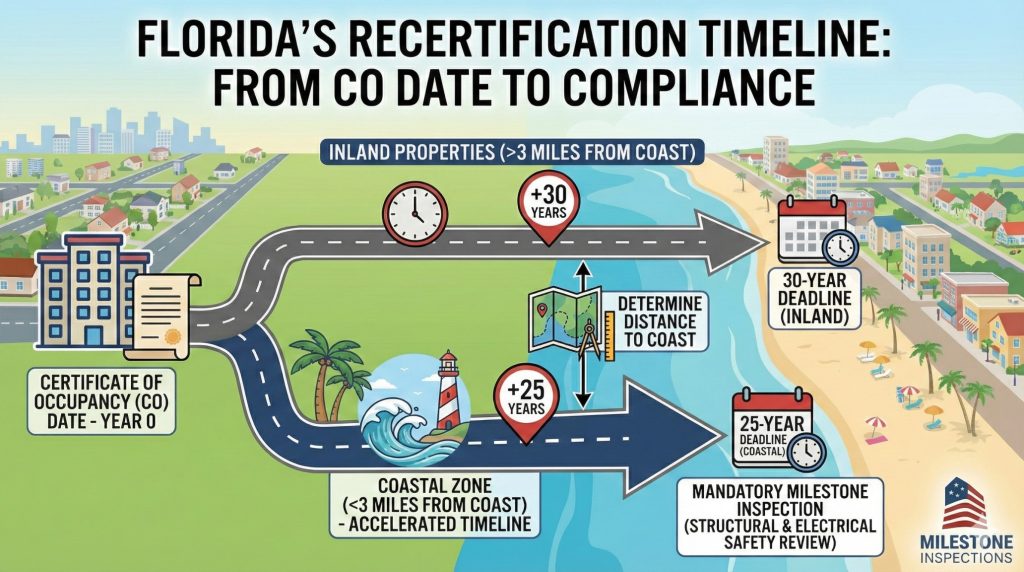
Under the new law, the mandatory 30 year recertification (officially known as the Milestone Inspection) applies to most condominium and cooperative association buildings that are three stories or taller. This means that if your building received its Certificate of Occupancy 30 years ago, you are now due for a structural and electrical safety review.
Does the “40 Year Recertification” Still Exist?
In conversation, yes. Many people in Miami-Dade and Broward counties still use the term 40 year recertification out of habit, and older buildings that have already passed their 30-year mark may still be on the older cycle until they catch up. However, legally speaking, the state has moved the goalposts. Relying on the old 40-year rule could leave your association non-compliant and facing significant fines.
The “Coastal Rule”: When 30 Years Becomes 25
There is a critical exception to the 30 year recertification rule that affects thousands of buildings in Florida. It is known as the “Coastal Zone” requirement.
If your building is located within three (3) miles of the coastline, your timeline is accelerated. Because the salty, humid coastal air is highly corrosive to concrete and steel (the “bones” of your building), these structures must undergo their first inspection at 25 years of age, rather than 30.
This 25 year recertification is strictly enforced. If you are in Miami Beach, Fort Lauderdale, Naples, or any coastal city, you likely fall into this category. It is vital to check your specific distance from the coast to confirm your deadline.
How to Calculate Your Specific Deadline
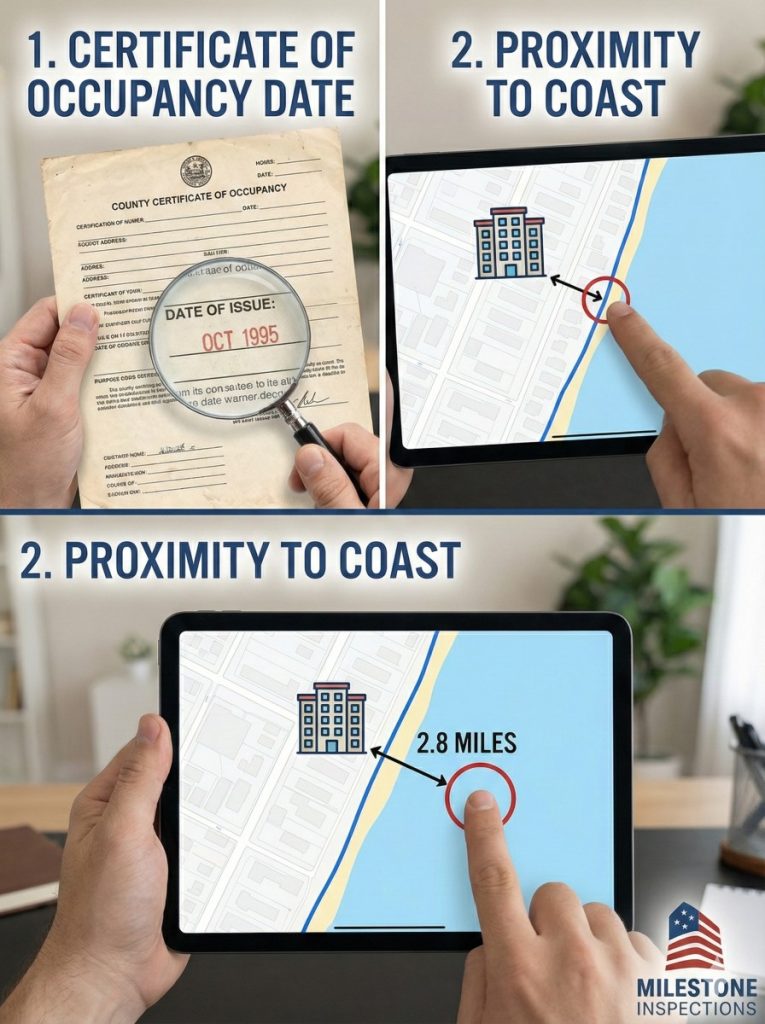
Determining your exact deadline requires two pieces of information:
- 1. The Certificate of Occupancy (CO) Date: This is the “birth certificate” of your building. You can find this on your county property appraiser’s website.
- 2. Your Proximity to the Coast: Use a mapping tool to measure the distance from your building to the coastline.
Once you have these, the math is simple. Add 30 years (or 25 years) to your CO date. That is the year your inspection is due. Note that all buildings that turned 30 (or 25) before July 1, 2022, generally had a deadline of December 31, 2024, to complete their initial studies. You can read the full text of the legislation on the Florida Senate Website to understand the specific legal wording.
The “Notice of Required Inspection”
Typically, the local building official (from your city or county) will send a formal “Notice of Required Inspection” to the condominium association when your building is due.
However, do not wait for this letter.
Administrative backlogs can delay these notices. The law places the ultimate responsibility on the building owner or association to comply, regardless of whether they received a letter. If you know your building age is approaching 25 or 30 years, you should proactively hire a licensed engineer to begin the process. Being proactive demonstrates good governance and protects the association from liability.

The Connection to the Structural Reserve Study Report
While preparing for your 30 year recertification, you must also address the other mandate: the Structural Integrity Reserve Study (SIRS). While the Milestone Inspection looks for current damage, the structural reserve study report is a financial plan for future repairs. The new laws require that these two efforts work in tandem.For example, if your Milestone Inspection reveals that the roof has 5 years of life left, that data must be accurately reflected in your structural reserve study report. This ensures that the association collects enough reserves to pay for the roof replacement when the time comes, avoiding a financial crisis. You can learn more about this on our SIRS information page.
What Happens During the Inspection?
Once you hire a firm, the process follows two phases:
Phase 1: Visual Screening
A licensed engineer performs a visual assessment of the habitable and non-habitable areas. They look for evidence of “substantial structural deterioration.” If the building is healthy, the process ends here.
Phase 2: Testing & Analysis
If signs of distress are found, a Phase 2 inspection is required. This may involve destructive testing (chipping concrete) to examine the steel rebar. This phase aims to determine the extent of the damage and prescribe a repair plan.
Get Your Compliance Roadmap Today
Navigating the shift from the old 40-year rule to the new 30 year recertification standard can be complex, but you don’t have to do it alone.
Our team of licensed professionals specializes in both Milestone Inspections and SIRS. We provide the expertise you need to protect your building and your residents.
Contact us today for a free consultation and let us help you determine your exact deadline and compliance strategy.
Request a Proposal
The fastest way to get answers is to call us directly. Our team is available to discuss your building’s specific needs.