Milestone certification Florida is the official compliance document your building receives after passing its mandatory structural inspection under Florida Senate Bill 4-D. If your condominium or commercial building is approaching its 25 or 30-year milestone, understanding the milestone certification process is essential for avoiding fines, special assessments, and legal liability.
Many Florida building owners and condo board members confuse the milestone certification with routine maintenance inspections. However, this certification carries legal weight — it confirms your building’s structural and life-safety systems meet current Florida Building Code standards.
At Milestone Inspections US, Registered Structural Engineer Paul Edwards Pineda, PE (FL PE #61808) has guided hundreds of Florida buildings through the milestone certification process, from initial assessment to final county approval.
Table of Contents
What Is Milestone Certification Florida?
Milestone certification Florida is the formal document issued when a licensed Professional Engineer (PE) or architect completes a structural inspection under Florida Statute 553.899. This certification confirms that your building has been professionally evaluated for structural integrity, electrical systems, and life-safety compliance.
The certification process was created after the tragic Champlain Towers South collapse in Surfside (2021), which killed 98 people. Florida legislators passed SB-4D to prevent similar tragedies by requiring systematic structural assessments of aging buildings statewide.
Step 1: Determine If Your Building Needs Milestone Certification
Not every Florida building needs milestone certification. Here are the requirements:
- Building type: Condominiums and commercial buildings 3 stories or taller (excluding single-family homes and townhomes)
- 30-year rule: Buildings that reached 30 years old by December 31, 2024, must complete their milestone certification Florida inspection by December 31, 2025
- 25-year coastal rule: Buildings within 3 miles of the coastline must begin at 25 years
- Recurrence: Every 10 years after the initial certification
Your local building department (Miami-Dade, Broward, Palm Beach, etc.) sends notification letters when your building is approaching its deadline. Don’t wait for the letter — check your deadline now.
Step 2: Hire a Qualified Structural Engineer
Florida law requires that milestone certification inspections be performed by a licensed Professional Engineer (PE) or licensed architect. For the best results, hire a Registered Structural Engineer — a rare credential requiring extensive experience specifically in structural analysis.
Why credentials matter for milestone certification Florida:
- A structural engineer specializes in load-bearing systems, concrete deterioration, and building safety — exactly what the milestone inspection evaluates
- Insurance companies and county reviewers give more weight to reports from structural PEs
- If Phase 2 is triggered, only a structural engineer can design the repair specifications
Paul Pineda’s qualifications:
- Florida Licensed Structural PE — #61808
- FL Threshold Inspector — #7026221
- Texas PE #116762 | Tennessee PE #124078
- FHA Consultant — #A0939

Step 3: Phase 1 — Visual Structural Assessment
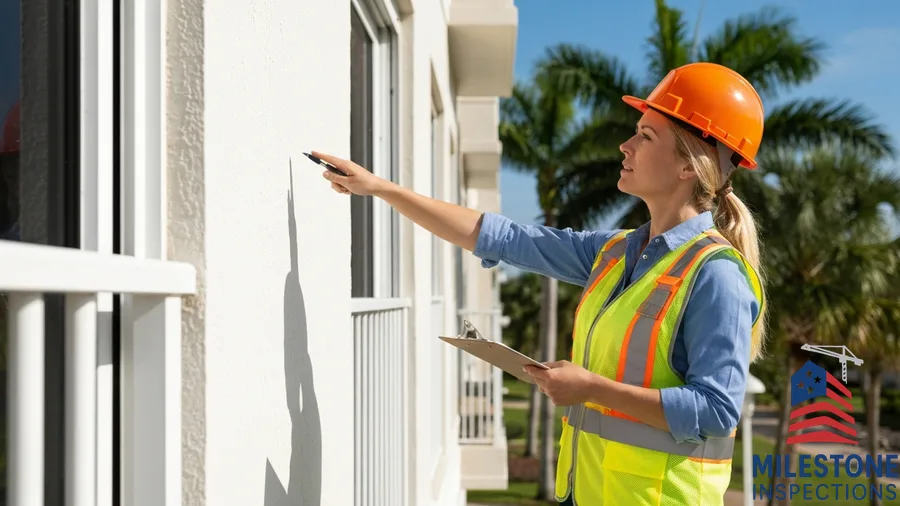
Phase 1 is the foundation of your milestone certification Florida. The engineer conducts a comprehensive visual examination of all structural and life-safety components:
- Foundation systems — settlement cracks, erosion, and displacement
- Load-bearing walls and columns — cracking patterns, concrete spalling, exposed rebar
- Floor and roof slabs — deflection, water damage, deteriorated post-tensioning
- Balconies and exterior walkways — structural connections, drainage, railings
- Parking structures — traffic membranes, corrosion, waterproofing
- Building envelope — windows, doors, weatherproofing systems
If the Phase 1 assessment finds no substantial structural deterioration, the engineer issues a sealed milestone certification report to your local building department. Your building is certified for the next 10 years.
Step 4: Phase 2 — Detailed Testing (If Required)
If Phase 1 reveals substantial structural deterioration, Florida law requires a Phase 2 investigation before milestone certification can be granted. Phase 2 includes:
- Concrete coring and compression testing — laboratory analysis of concrete strength and condition
- Chloride ion analysis — measures saltwater intrusion depth, critical for coastal Florida buildings
- Ground-penetrating radar (GPR) — maps reinforcing steel location and corrosion without destructive testing
- Half-cell potential testing — identifies active corrosion in reinforcing steel
- Structural load analysis — computer modeling to verify building safety under current and future loads
Phase 2 produces a detailed engineering report with repair recommendations, cost estimates, and priority timelines. This report becomes the basis for your milestone certification Florida remediation plan.
Step 5: Submit the Sealed Report to Your County
After completing the inspection, your engineer prepares a sealed report and submits it to your local building department. The report includes:
- Phase 1 findings with photographic documentation
- Phase 2 test results (if applicable)
- Engineer’s professional opinion on structural safety
- Repair recommendations with priority classifications
- Estimated costs for required repairs
The county reviews the report and, if satisfactory, issues the official milestone certification Florida compliance confirmation. This is filed as a public record.
Step 6: Complete Required Repairs
If your milestone certification report identifies repairs, the association must develop a remediation plan. Common repairs identified during milestone certification Florida inspections include:
- Concrete restoration — patching spalled concrete, replacing deteriorated sections, applying protective coatings
- Waterproofing repairs — roof membrane replacement, joint sealant renewal, balcony drainage improvements
- Structural reinforcement — carbon fiber wrapping, steel plate additions, post-tensioning cable repair
- Railing and guardrail replacement — bringing safety barriers up to current code
Your engineer oversees contractor work to ensure repairs meet the specifications in the milestone certification report.
Step 7: Connect Milestone Certification to Your SIRS
Your milestone certification Florida findings directly feed into your building’s Structural Integrity Reserve Study (SIRS). Florida law requires condominiums 3 stories or taller to maintain a SIRS that accounts for:
- Roof replacement reserves
- Structural component replacement and repair
- Waterproofing system maintenance
- Load-bearing wall and floor system reserves
The milestone certification inspection findings inform the SIRS cost projections and reserve funding schedule. Having the same engineer perform both assessments ensures consistency and accuracy. Learn the difference between milestone inspections and SIRS.
Milestone Certification Florida: Cost and Timeline
The cost of milestone certification Florida depends on your building’s size, age, and condition:
- Phase 1 only: Typically ranges from $3,000 to $15,000 depending on building size and number of units
- Phase 2 (if needed): Additional $5,000 to $30,000+ for detailed testing and analysis
- Timeline: Phase 1 takes 1-3 weeks; Phase 2 adds 3-6 weeks; full certification within 60-90 days
Delaying your milestone certification costs more than acting early. Buildings that miss deadlines face county enforcement actions, potential fines, and difficulty selling individual units. For a personalized estimate, view our pricing guide or request a free proposal.
Milestone Certification Florida: Frequently Asked Questions
What happens if we miss the milestone certification Florida deadline?
Your local building department can issue violation notices, impose fines, and restrict unit sales. Condo boards may face personal liability for failing to comply with milestone certification requirements under Florida law.
Can our building fail milestone certification?
Buildings don’t technically “fail” — but if Phase 1 reveals substantial deterioration, Phase 2 is required with mandatory repairs. The milestone certification Florida process ensures buildings are eventually brought to compliance.
Is milestone certification the same as 40-year recertification?
They overlap but are different programs. Milestone certification is a statewide requirement under SB-4D. The 40-year recertification is a local requirement in Miami-Dade and Broward counties. Buildings in those counties must comply with both.
How often does milestone certification need to be renewed?
After the initial milestone certification Florida, buildings must be re-inspected and re-certified every 10 years. The cycle continues for the life of the building.
Who pays for milestone certification in a condo?
The condominium association is responsible for funding the milestone certification inspection and any required repairs. Costs are typically covered through reserves or special assessments approved by the board.
Start Your Milestone Certification Florida Today
Don’t wait until your deadline arrives. Early milestone certification Florida gives your association time to plan, budget, and complete any required repairs without emergency pressure.
Paul Edwards Pineda, PE — Registered Structural Engineer — provides comprehensive, code-compliant milestone certification inspections throughout Florida.
Call 305-890-6333 or request a free proposal.
Serving all of Florida: Miami, Fort Lauderdale, Naples, West Palm Beach, Miami Beach, and Tampa.
Request Your Milestone Certification Proposal
Get a detailed proposal for your building’s milestone certification Florida inspection. Our team responds within 24 hours.
We are available 24/7
305-890-6333
Tambien hablamos español
Related Services
- Full service overview: milestone inspections Florida
Need a Licensed Structural Engineer?
Paul Edwards Pineda, PE — Registered Structural Engineer
FL PE #61808 | FL Threshold Inspector #7026221 | TX PE #116762 | TN PE #124078 | FHA #A0939
Get a Free Proposal